Stop studying chess without a plan.
Follow a system and improve with direction.

Learn exactly what to study at each stage of your level, with a structured method from beginner to advanced and handpicked practice exercises to reinforce the most important themes.

  • 307 organized video lessons

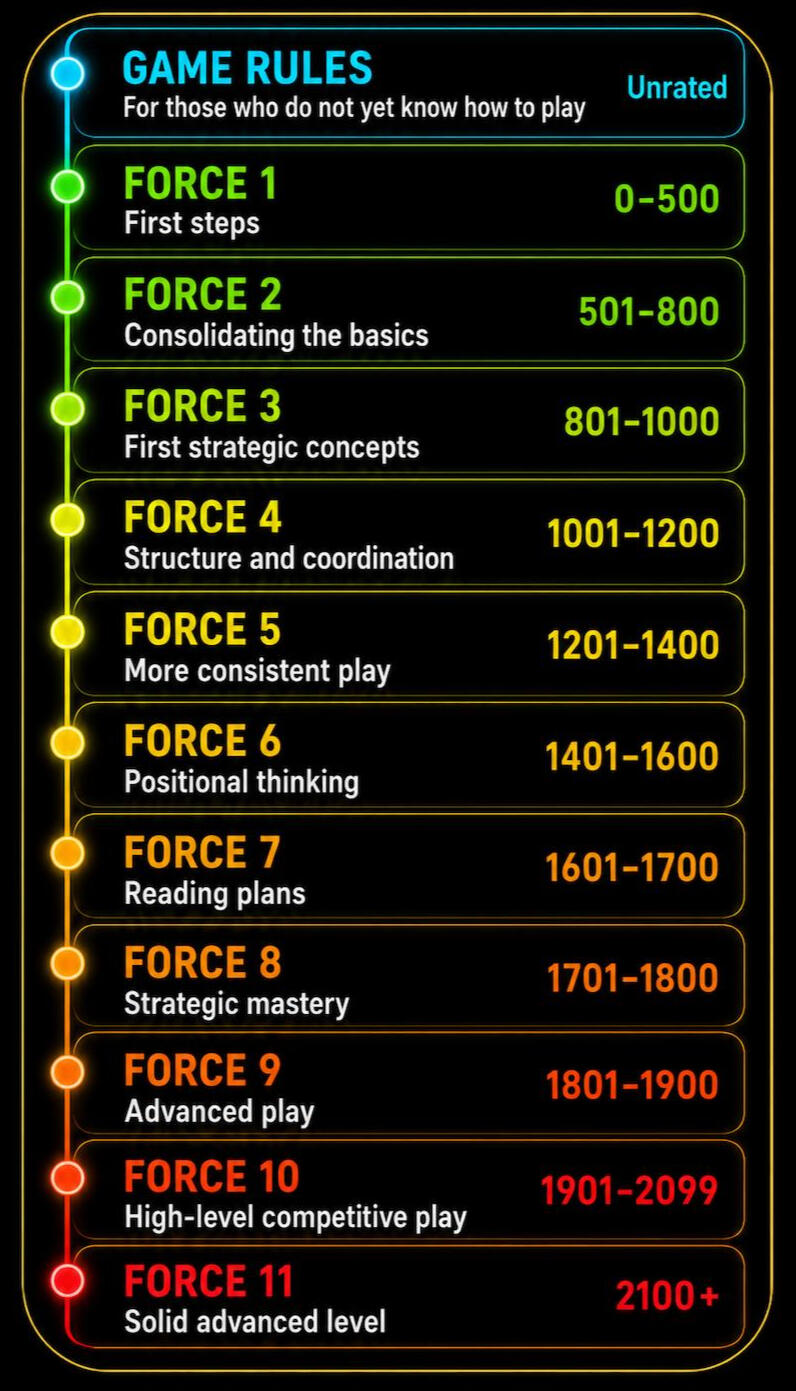
  • Game Rules + 11 learning paths by rating range

  • Handpicked practice exercises on Lichess.org

  • Lifetime access, no monthly fees

The problem is not a lack of content.
It is studying without direction.

Today, most chess players learn like this:

  • watching random videos on YouTube

  • solving tactics without knowing when to apply them

  • studying openings today and endgames tomorrow

  • not knowing what to study next

The result:
you study, but you do not know if you are truly improving.

The secret is not studying more.
It is studying in the right order.

In chess, each stage requires different types of training.A beginner does not need to study complex endgames before learning how to stop hanging pieces.And an intermediate player will not keep improving by simply repeating the basic fundamentals.

Real improvement depends on sequence.

Meet the ChessForce System

A progressive chess training system designed to organize your study by rating range — from your very first contact with the game to advanced levels.With ChessForce, you do not get a pile of disconnected lessons. You follow a clear structure, with learning paths organized by playing strength, combining theory, tactics, strategy, endgames, openings, and handpicked practice at the right moment in your development.

Find your level

Start at the right stage: Game Rules or one of the 11 rating-based learning paths.
Study in the right order

Learn the right content for your stage: tactics, strategy, endgames, openings, and attack.

Practice and improve

Apply what you learn with handpicked exercises and focused practice.

You know where you are, what to study now, and what the next step is.


Each stage of chess requires a different type of training.

What helps a beginner improve is not necessarily what helps an intermediate or advanced player.That is why trying to study everything at once can hurt more than it helps.At the beginning, the most important things are to stop making basic mistakes, understand how the pieces work, recognize simple checkmates, and play with more confidence.Later, the focus changes: calculation, tactics, endgames, openings, plans, and strategy start to carry more weight.At higher levels, improvement depends on deeper decisions: pawn structures, strong squares, piece activity, repertoire, endgames, and positional understanding.
Beginner

Avoid basic mistakes, understand the rules, recognize simple checkmates, and play with more confidence.
Intermediate

Improve calculation, tactics, endgames, and openings, and begin building plans more clearly.
Advanced

Deepen your understanding of strategy, structures, repertoire, decision-making, and positional play.

You do not study everything at the same time.You study what matters most for your current level.

One learning path for each stage of your development

ChessForce organizes your study into one starting stage and 11 progressive learning paths by rating range.Use your Chess.com rating, your Lichess.org rating, or the level you usually play at in your chess app as a reference.If you are starting from scratch, begin with the Game Rules stage.If you already play, choose the learning path that is closest to your current level.
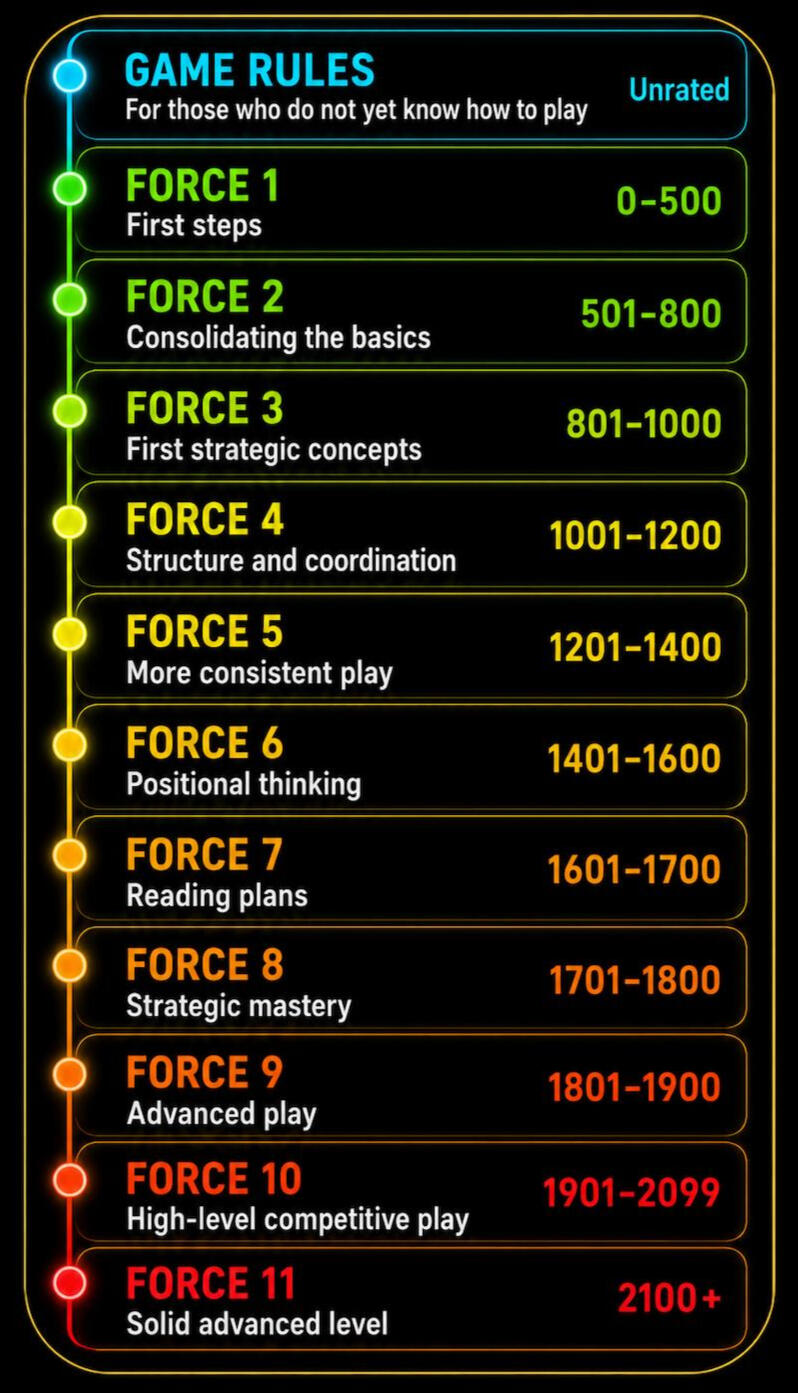
Choose your current rating range, enter the corresponding learning path, and follow the sequence step by step.

Inside each learning path, you develop the right skills to improve.

ChessForce does not focus on just one area of chess. It combines fundamentals, tactics, strategy, endgames, openings, and practice to build more complete improvement.Instead of studying isolated topics, you follow organized lessons designed to develop the most important areas of your game.

Tactics

Essential patterns such as pins, forks, discovered attacks, double threats, and combinations.

Checkmate

Checkmate patterns, attacking formulas against the king, and recognition of decisive positions.

Strategy

Plans, strong squares, the center, space, pawn structures, and piece coordination.

Endgames

Fundamental techniques to convert advantages, defend difficult positions, and play with confidence.

Openings

Principles, repertoires, structures, and typical plans to get a good start out of the opening.

Attack

How to open lines, coordinate pieces, and turn initiative into real pressure.

Grandmasters

Model games, classical ideas, and examples of high-level chess thinking.

Practice

Handpicked exercises to reinforce important themes from the course.

You do not just watch lessons.You develop real areas of your game.


At key moments in the course, you also practice.

In addition to the lessons, ChessForce includes handpicked practice activities to reinforce essential themes on the board.Some topics simply need to be understood clearly.Others need to be trained until they become practical recognition.That is why, at strategic points in the course, you will find activities called CLD — ChessForce Learning Drills.These are selected practice activities designed to help you review important themes, recognize patterns, and apply the ideas studied in the lessons.Whenever a practice activity is available, it works as a bridge between the explanation and real training on the board.

Understand

First, you learn the concept through clear and progressive explanations.
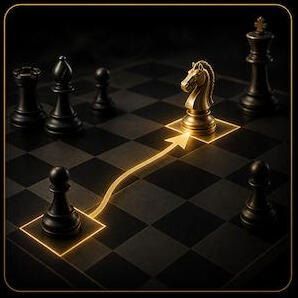
Reinforce

In selected themes, you review the idea with exercises and practical positions.
Apply

You bring the pattern you studied into your own games with more awareness.

The goal is not just to watch.
It is to learn, review, and practice the most important themes.


Bonus: ChessForce Think Deeper

Special lessons with visual positional analysis to help you see the board with greater depth.Some chess ideas are difficult to understand through verbal explanation alone.Concepts such as square control, space, the center, piece activity, pawn structures, and strategic plans become much clearer when they are visualized directly on the board.That is why ChessForce includes bonus lessons with ChessForce Think Deeper, a visual approach created to help you understand positional ideas in a deeper and more intuitive way.

Square control

Visualize which squares are being controlled and why that matters.

Space and the center

Understand how territorial control influences plans and piece freedom.
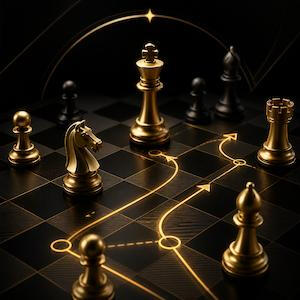
Positional plans

Learn how to connect structure, pieces, and strategic goals within the game.

You begin to see not only the moves,
but the hidden ideas behind the position.


What you get when you join ChessForce

A complete study system to organize your chess improvement — with lessons, progressive learning paths, handpicked practice activities, and special bonuses.When you join ChessForce, you do not receive just a collection of disconnected lessons.You receive an organized study structure designed to guide your development, from the fundamentals of the game to more advanced content in tactics, strategy, endgames, openings, attack, and positional analysis.

  • 307 organized video lessons: structured lessons designed to help you study with clarity, following a logical sequence instead of depending on random content.

  • Starting stage — Game Rules: a complete foundation for anyone starting from zero or needing to review the fundamentals before moving into the rating-based learning paths.

  • 11 rating-based learning paths: from Force 1 to Force 11, with a progression designed for different playing levels, from beginner to advanced.

  • Essential chess content: tactics, checkmate, strategy, endgames, openings, attack, grandmaster games, repertoires, and organized practice.

  • CLD — ChessForce Learning Drills: selected exercises and practice activities to review patterns, apply ideas, and turn what you study into real training.

  • Bonus: ChessForce Think Deeper: special lessons with visual positional analysis to help you see squares, the center, space, pieces, structures, and plans with greater depth.

  • AI Chess Tutor: an artificial intelligence tool integrated into the members area, trained with the course content, so you can interact, ask questions, and clarify doubts about the lessons inside the platform.

  • Certificate of completion: as you progress through the lessons and complete the course, you will be able to issue your certificate of completion through the platform.

  • Lifetime access: study at your own pace, with no monthly fees, and return to the lessons whenever you want.

  • New updates: whenever new content is added to ChessForce, you continue receiving access inside your student area.

  • Access through Hotmart: study through the Hotmart members area on your computer or through the mobile app. With the app, you can follow the lessons on your smartphone and, when available, download content to watch offline.

You join once and receive a complete structure to study, review, and improve at your own pace.

See inside the complete ChessForce structure

The content is organized step by step inside each of the 11 learning paths, so you know exactly what to study at every stage of your development.

437 total lessons and resources
307 video lessons & study materials
45h 25min
of content
Inglês
Audio: English
1
Start Here: How to Study with the ChessForce System
Welcome: Where to Start
The ChessForce Mission
What ♞CLDs Are
Software and Apps to Support the Lessons
2
Rules of the Game
Introduction: How to Play Chess
The Board [♞CLD] 155 06:07
[♞CLD] Board Fundamentals
The Material [♞CLD] 156 10:35
The Pawn [♞CLD] 157 18:45
The King [♞CLD] 158 15:07
The Queen [♞CLD] 159 07:39
Check and Checkmate | 160 17:37
Stalemate | 161 06:53
Checkmate with King and Queen vs. King [♞CLD] 162 17:21
The Rook [♞CLD] 163 05:57
Checkmate with King and Rook vs. King [♞CLD] 164 19:55
Checkmate with Two Major Pieces [♞CLD] 165 08:52
The Bishop [♞CLD] 166 08:05
The Knight [♞CLD] 167 11:15
[♞CLD] King Defense: Essential Strategy
Castling [♞CLD] 168 06:55
En Passant [♞CLD] 169 06:42
Checkmate in 1 Move Training [♞CLD] 170-1 17:24
How to read or notate a chess game? Practical example: Scholar's Mate
Where to Play Online
3
[Opening] Acceleration: quick tips (overview)
Develop All Your Pieces Quickly 00:57
Don't make unnecessary pawn moves 00:53
Keep Your Pieces as Close to the Center as Possible 01:01
Do Not Move the Same Piece Twice During the Opening 00:30
Develop Knights Before Bishops 00:42
Always Create a Threat 00:34
Keep the knights near the center 00:40
Castle as Quickly as Possible 00:38
Kingside Castling Is Safer than Queenside Castling 01:02
Rooks Should Quickly Occupy Open or Semi-Open Files 00:35
In the Opening, Place the Queen Behind Your Own Pawn Line 00:30
Never trade a developed piece for an undeveloped one 00:24
Keep Your Bishops Active 00:24
As Pawns Advance, They Become Harder to Protect 00:23
Place Your Pawns in the Center 00:24
Control as much territory as possible 00:23
Do Not Give Unnecessary Checks 00:20
Do Not Open the Position if You Are Behind in Development 00:43
Avoid Unnecessary Exchanges 00:59
Try to Prevent Your Opponent from Castling 00:32
Try to free yourself from all pins 00:34
Keep Your Pieces Protected 00:31
The Value of the Pieces Varies According to the Position 00:51
Pawns Are the Foundation of Strategy 00:46
Pawn Weaknesses Are Long-Term 00:28
Avoid Doubled Pawns 00:38
Avoid Isolated Pawns 00:43
Avoid Backward Pawns 00:32
Avoid Pawn Islands 00:36
Avoid Creating Weak Squares 00:31
Avoid Advancing Hanging Pawns 00:38
Avoid Advancing the Pawns that Protect Your King 00:59
Be Careful When Advancing Pawns to Gain Space 00:40
In Pawn Exchanges, Try to Bring Them as Close to the Center as Possible 00:39
Always Expect Your Opponent to Make the Best Moves 00:30
Not Every Weakness Is Bad 00:31
All Rules Were Made to Be Broken 00:47
[Book] 37 Tips to Play the Openings Better
4
[Middlegame] Acceleration: Quick Tips Overview
Think about defense first 00:25
Evaluate the changes that occur after your opponent's move 00:33
Do Not Leave Your Pieces Overloaded 00:31
Don't recapture pieces automatically 00:29
Never Leave the King in Danger of Check 00:18
Avoid Placing Heavy Pieces in the Line of Action of Minor Pieces 00:17
If You Have Little Space, Try to Exchange One or Two Pieces 00:17
Eliminate Your Opponent’s Best Piece 00:15
Try to Anticipate Your Opponent’s Threats 00:30
Improve the Position of Your Pieces 00:23
Restrict the Movement of Enemy Pieces 00:19
Trap One of Your Opponent’s Pieces 00:18
Create New Weaknesses in the Enemy Camp 00:24
Plan Hypothetical Exchanges 00:22
Whenever You Have a Material Advantage, Simplify 00:20
Put Pressure on Your Opponent’s Backward Pawn 00:20
Force the Advance of Your Opponent’s Hanging Pawns 00:20
Whenever Possible, Create a Passed Pawn 00:23
Always Block Your Opponent’s Passed Pawns 00:28
Whoever has the pawn majority on the flank far from the enemy king should simplify the game 00:28
The Minority Attack 00:23
The Knight Is the Best Piece to Block a Passed Pawn 00:27
Knights Need Outposts 00:29
Keep Your Pieces on Squares of a Different Color from Your Opponent’s Bishop 00:19
Watch the Squares Controlled by Your Opponent’s Bishop 00:27
If Your Opponent Has Two Bishops, Try to Exchange One of Them 00:19
Exchange the opponent's fianchettoed bishop 00:22
Whenever possible, place your rooks on the 7th or 8th ranks 00:18
Double your rooks on the 7th rank 00:21
[Book] 29 tips to play the middlegame better
5
[Middlegame] Captures, Exchanges, Introduction to openings...
Capturing free pieces [♞CLD] 308 04:30
[♞CLD] The art of defense
[♞CLD] The art of the smart capture
[♞CLD] Strategy in two moves
The comparative value of the pieces [♞CLD] 309 10:19
How to tell whether an exchange is worthwhile | 310 - 312 16:04
22 examples of rapid games
6
[Endgame] Acceleration: quick tips (overview)
A bishop is worth more than a knight in open positions 00:32
A knight is worth more than a bishop in closed positions 00:24
In endgames with mobile pawns, the bishop is generally worth more than the knight 00:29
Two bishops are stronger than bishop and knight, and much stronger than two knights 00:40
How to fight against bishop and knight 00:30
How to fight against two bishops 00:27
Bishops should be placed in front of the pawn chain 00:24
A bishop can dominate a knight 00:22
Opposite-colored bishop endgames generally end in a draw 00:29
Put your opponent in zugzwang 00:35
Mantén tus peones en casillas del mismo color que el alfil de tu adversario 00:25
Keep your pawns on squares of a different color from your own bishop 00:23
If you have a majority, create a passed pawn 00:26
When you have an extra pawn, exchange pieces and not pawns 00:17
Rook pawns are very strong against knights 00:21
A pawn shouldn't always promote to a queen 00:22
In endgames, keep your rooks active 00:19
Always place a rook behind a passed pawn 00:17
The side that is down the exchange should avoid trading the other rook 00:21
Centralize the queen in endgames 00:25
In endgames, centralize your king as quickly as possible 00:30
The king must be active in the endgame 00:18
Many wins are based on winning the opposition 00:25
Keep your rearguard protected 00:19
Never make your opponent's job easier 00:24
[Book] 25 tips to play endgames better
7
[Attack] Acceleration: quick tips (overview)
Control the center before attacking 00:17
If the opponent attacks on a flank, counterattack in the center 00:19
Accumulate advantages before attacking 00:18
Open ranks, files and diagonals 00:21
Eliminate the key pieces of the opponent's defense 00:22
Avoid exchanges when you are attacking 00:21
Quickly switch your attack from one flank to another 00:22
Concentrate your forces on the opponent's weak points 00:19
When attacking, concentrate the maximum of your forces 00:19
After an attack, reorganize your pieces 00:18
[Book] 10 tips to play the attack better
8
[Tactics] Material advantage
Pin [♞CLD] 197 - 199 11:01
Skewer [♞CLD] 200 03:12
Double attack [♞CLD] 201 02:54
Knight fork [♞CLD] 202 - 204 09:34
Distraction [♞CLD] 205 04:24
Discovered attack [♞CLD] 206 - 208 09:24
Discovered check [♞CLD] 209 - 211 10:25
Double check [♞CLD] 212 04:42
Double threat | 213 03:06
Back-rank mate [♞CLD] 214 02:14
Zugzwang [♞CLD] 215 02:47
Pawn promotion | 216 04:31
Draw | 217 02:52
Perpetual check | 218 04:15
Puzzles: test your tactics knowledge so far | 219 - 221 13:08
[♞CLD] Hanging piece
[♞CLD] Trapped piece
[♞CLD] Overloaded piece
[♞CLD] Quiet move
[♞CLD] Intermediate move (Zwischenzug)
[♞CLD] X-ray attack
[♞CLD] Interference
[♞CLD] Attraction
[♞CLD] Underpromotion
[♞CLD] Desperado piece
[♞CLD] Counter check
[♞CLD] Capturing the defender (Removing the Defender)
[♞CLD] Clearance
[♞CLD] Defensive move
[♞CLD] Sacrifice
9
[Opening and middlegame] Control of the center
Control of the center: the "classical" point of view | 313 11:25
Control of the center: the "hypermodern" point of view | 314 13:17
Enough theory! Shall we study a game before continuing your training? | 315 18:35
10
[Middlegame] Positional advantage
Introduction
Simplification technique: concept | 222 12:48
The strength of a passed pawn: concept | 223 - 224 09:48
Concept: backward pawns and outposts (holes): concept | 225 06:51
How pawn structure influences the mobility of the minor pieces | 226 05:51
Inferior color complex: concept | 227 - 228 12:28
Reinforcement exercises | 229 - 230 08:21
Pawn majority and minority: concept | 231 07:00
Open center and closed center: concept | 232 08:54
Pawn chain: concept | 233 05:18
Space: concept | 234 - 235 09:44
Mobile pawn center - Morphy vs Hampton | 236 07:18
Kings in the center - Alekhine vs. Euwe | 237 07:27
Hunting the king in the middlegame | 238 10:20
Hungry for the f7 and f2 squares: the Fegatello (Fried Liver) Attack and the Traxler Counterattack [CLD] 239 10:41
Castling on opposite sides of the board | 240 19:38
Be careful when the center is still open | 241 11:39
The blocked center: concept | 242 11:27
Use the pieces to create weaknesses in the opponent's camp and gain space | 243 15:08
The price of delay in development | 244 06:03
Seek the advantage in development | 245 08:49
An important tip for developing your rooks | 246 14:13
Problems with rooks in closed positions | 247 08:37
Example of strategy in a closed position: Grischuk vs. Short | 248 11:11
The isolated queen's pawn: concept | 249 07:55
Practical example I: isolated queen's pawn - Korchnoi vs. Karpov | 250 14:23
Practical example II: isolated queen's pawn - Carlsen vs. Granda Zuniga | 251 09:49
Rubinstein vs Salwe: Fighting against the backward pawn | 252 11:39
Karjakin vs Anand: voluntarily creating a backward pawn as strategy? | 253 08:37
Fischer vs. Spassky: Blocked hanging pawns | 254 19:10
Taimanov vs. Tal: Mobile hanging pawns | 255 13:08
Concept: learn the strategy of the minority attack | 256 06:50
Practice: how to execute the minority attack? - Seirawan vs. Ippolito | 257 10:36
Practice: how to defend against the minority attack? - Tisdall vs. Sveshnikov | 258 11:24
Be careful when moving your pawns in the opening phase | 259 08:56
Smyslov vs. Rudakovsky: Central outpost | 260 09:27
How Kasparov eliminated a central outpost (Arnason vs. Kasparov) | 261 08:19
11
[Middlegame] [♞CLDs]
[♞CLD] Tactics in the middlegame
[♞CLD] Various tactical themes
12
[Attack] Kingside Castling (0-0)
Introduction to the Series "How to Attack the Kingside Castle (0-0)"
Attack against the Pawn on g7 | 170 - 171 13:38
Attack against the Pawn on h7 | 172 - 174 21:05
Attack against the Pawns on g7 and h7 | 175 - 177 19:13
Attack against the Pawns on f7 and h7 | 178 - 179 22:10
Attack against the Pawn on h6 | 180 - 181 15:20
Attack along the b1-h7 Diagonal | 182 - 183 10:09
Attack along the a1-h8 Diagonal | 184 - 185 10:46
Attack along the Knight's File without the Pawn | 186 05:05
Bishop Sacrifice on g5 or g4 | 187 04:20
Attack on the Back Rank | 188 04:43
Attack through the f6 Square | 189 - 190 10:14
Attack along the Rook's Open File | 191 03:03
Attack along the Rook's File and Advanced Pawn on the g-File | 192 04:51
Attack with the Advance of the Bishop's File Pawn | 193 06:23
Advance of the Rook Pawn against an Enemy Bishop in Fianchetto | 194 03:26
Advance of the Rook and Knight Pawns | 195 - 196 08:41
13
[Checkmate] Patterns
Introduction to the checkmate patterns
Anastasia's Mate Part A [♞CLD] 262 - 264 36:37
Anastasia's Mate Part B [♞CLD] 265 - 267 36:33
Opera Mate Part A [♞CLD] 268 - 269 28:09
Opera Mate Part B [♞CLD] 270 - 271 27:50
Train Mate | 272 - 273 22:13
Arabian Mate Part A [♞CLD] 274 - 276 37:43
Arabian Mate Part B [♞CLD] 277 - 278 23:51
Smothered Mate [♞CLD] 279 - 280 19:46
Kill Box | Coffin Mate [♞CLD] 281 - 283 37:59
Pillsbury's Mate [♞CLD] 284 10:48
Ladder Mate | 285 - 286 22:50
Damiano's Mate | 287 13:00
Damiano's Bishop Mate | 288 15:33
Vukovic Mate [♞CLD] 289 16:03
Lolli's Mate | 290 - 291 16:55
Morphy's Mate [♞CLD] 292 12:37
Triangle Mate [♞CLD] 293 18:28
Hook Mate [♞CLD] 294 18:45
Dovetail Mate [♞CLD] 295 16:44
Dovetail Mate with Bishop | 296 13:26
Boden's Mate [♞CLD] 297 15:23
Epaulette Mate [♞CLD] 298 13:09
Mate with the Bishop Pair [♞CLD] 299 13:52
Greco's Mate | 300 11:53
Balestra Mate [♞CLD] 301 12:37
Pawn Mate | 302 16:40
Guéridon Mate (Swallow's Tail) [♞CLD] 303 15:46
Blackburne's Mate | 304 10:01
Suffocation Mate [♞CLD] 305 14:05
Rodo Mate | 306 16:46
Back-rank Mate [♞CLD] 307 12:59
14
[Endgame] [Very important!]
Introduction to endgames
King vs. pawn Part A [♞CLD] 01 - 03 25:24
King vs. pawn Part B [♞CLD] 04 - 06 42:04
King vs. pawn Part C [♞CLD] 07 - 08 08:12
Queen vs. pawn Part A [♞CLD] 09 - 10 15:47
Queen vs. pawn Part B [♞CLD] 11 - 12 23:06
Rook vs. pawn Part A | 13 - 15 21:41
Rook vs. pawn Part B | 16 - 18 22:13
Rook vs. pawn Part C | 19 - 21 12:05
Rook vs. 2 pawns Part A | 22 - 24 28:44
Rook vs. 2 pawns Part B | 25 - 26 23:29
Rook vs. bishop | 27 26:20
Rook vs. knight | 28 26:05
Bishop vs. pawns | 29 - 31 34:07
(Bishop + pawn) vs. king | 32 - 33 28:37
Bishop vs. (same-colored bishop + pawn) | 34 - 36 28:33
Bishop vs. (same-colored bishop + 2 pawns) 37 18:41
(Bishop + pawns) vs. (same-colored bishop + pawns) 38 - 39 32:55
Bishop vs. (opposite-colored bishop + pawns) - Part A | 40 - 41 21:09
Bishop vs. (opposite-colored bishop + pawns) - Part B | 42 - 43 17:16
(Bishop + pawns) vs. (opposite-colored bishop + pawns) | 44 20:01
Knight vs. pawn | 45 to 47 26:07
Knight vs. pawns | 48 to 50 29:46
(Knight + pawn) vs. pawn | 51 - 52 26:03
(Knight + pawns) vs. pawns | 53 - 54 24:12
(Knight + pawns) vs. knight | 55 - 57 31:08
(Knight + pawns) vs. (knight + pawns) | 58 - 59 20:57
Knight vs. (bishop + pawn) - Part A | 60 - 62 33:25
Knight vs. (bishop + pawn) - Part B | 63 - 64 13:36
Bishop vs. (knight + pawn) | 65 - 67 29:54
Bishop vs. knight - Various I - 68 - 69 16:18
Bishop vs. knight - Various II - 70 - 71 18:10
(Knight + pawns) vs. (bishop + pawns) - material advantage | 72 - 73 15:36
Bishop superior to the knight - positional advantage | 74 - 75 20:38
Knight superior to the bishop - positional advantage | 76 - 78 17:57
Bishop / knight - better pawn structure and superior king - positional advantage | 79 - 80 18:47
(Bishop + knight + pawns) vs. (bishop + knight + pawns) | 81 - 83 15:26
Playing with two bishops. When is it worth simplifying? | 84 - 85 14:16
Two minor pieces against one | 86 08:31
(Rook + pawn) vs. rook - Philidor and Lucena [♞CLD] | 87 - 88 06:25
(Rook + pawn) vs. rook - How to defend against the Lucena position [♞CLD] 89 - 90 08:50
(Rook + pawn) vs. rook - The first-rank defense method [♞CLD] 91 07:45
The K & H defense method [♞CLD] 92 - 94 14:23
(Rook + pawn) vs. rook - Vertical cut - Grigoriev method [♞CLD] 95 - 96 15:48
(Rook + pawn) vs. rook - Vertical cut - Mating method [♞CLD] 97 - 98 09:58
(Rook + pawn) vs. rook - Vertical cut - Techniques for winning with the knight pawn [♞CLD] 99 - 101 08:47
(Rook + pawn) vs. rook - Horizontal cut [♞CLD] 102 - 104 14:42
(Rook + pawn) vs. rook - Rook pawn on the 7th: strong side's rook in front [♞CLD] 105 07:18
(Rook + pawn) vs. rook - Rook pawn on the 6th: Vancura defense [♞CLD] 106 - 107 11:22
(Rook + pawn) vs. rook - Rook pawn on the 7th: strong side's king in front [♞CLD] 108 - 110 08:57
(Rook + pawn) vs. rook - Rook pawn: support of the king and rook [♞CLD] 111 - 112 07:20
(Rook + 2 pawns) vs. rook - doubled pawns on central / bishop files | 113 - 114 13:40
(Rook + 2 pawns) vs. rook - doubled pawns on knight / rook files | 115 - 117 08:08
(Rook + 2 pawns) vs. rook - rook and bishop pawns on the same flank - winning technique - Part A | 118 - 120 14:28
(Rook + 2 pawns) vs. rook - rook and bishop pawns on the same flank - winning technique - Part B | 121 - 122 06:36
(Rook + 2 pawns) vs. rook - rook and bishop pawns on the same flank - drawing technique | 123 - 124 07:07
(Rook + 2 pawns) vs. rook - connected and blocked pawns | 125 - 127 09:50
(Rook + 2 pawns) vs. rook - rook trapped in front of the pawn on the 7th - Part A | 128 - 130 07:00
(Rook + 2 pawns) vs. rook - rook trapped in front of the pawn on the 7th - Part B | 131 - 132 05:16
(Rook + 2 pawns) vs. rook - Vancura defense against 2 pawns | 133 09:11
(Rook + 2 connected passed pawns) vs (rook + pawn) 134 - 136 13:45
(Rook + 2 isolated passed pawns) vs. (rook + pawn) 137 04:26
(Rook + 2 pawns - passed/blocked) vs (rook + pawn) 138 - 139 08:40
(Rook + 2 pawns - no passed pawn) vs (rook + pawn) 140 05:58
Rook endgame - material advantage - flank passed pawn - rook in front [♞CLD] 141 06:55
Rook endgame - material advantage - flank passed pawn - rook behind [♞CLD] 142 - 143 11:41
Rook endgame - material advantage - flank passed pawn - rook beside it [♞CLD] 144 05:59
Rook endgame - material advantage - flank passed pawn - opponent's king blockading [♞CLD] 145 05:58
Rook endgame - material advantage - flank passed pawn - opponent's king far away [♞CLD] 146 05:43
Rook endgame - material advantage - flank passed pawn - pawn imbalance [♞CLD] 147 - 148 08:29
Rook endgame - material advantage - potential flank passed pawn [♞CLD] 149 06:32
Rook endgame - material advantage - potential flank passed pawn - strategy for the weaker side to draw [♞CLD] 150 05:42
Fortress: 2 bishops vs. queen | 151 08:36
Fortress: bishop + knight vs. queen | 152 04:59
Fortress: 2 knights vs. queen | 153 07:09
Fortress: rook pawn on the 2nd rank | 154 04:15
Queen vs. bishop [♞CLD]
Queen vs. knight [♞CLD]
Queen vs. rook [♞CLD]
Checkmate with 2 bishops: only 60 seconds left! [♞CLD] 316 23:08
Checkmate with knight and bishop: the W method [♞CLD]
Checkmate with knight and bishop: the Delétang method [♞CLD]
15
[Endgame] [♞CLDs]
[♞CLD] rook and pawn endgames
[♞CLD] bishop and pawn endgames
[♞CLD] knight and pawn endgames
[♞CLD] queen and pawn endgames
[♞CLD] endgames with queen, rook and pawns
[♞CLD] The strength of the pawn in promotion
[♞CLD] endgames with different compositions
16
[Checkmates] [♞CLDs]
[CLD] Mate in 1
[CLD] Mate in 2
[CLD] Mate in 3
[CLD] Mate in 4
[CLD] Mate-in-5 challenge
17
[Attack] [♞CLDs]
[♞CLD] The art of the sacrifice
[♞CLD] attacking the kingside castle!
[♞CLD] attacking the exposed king
[♞CLD] attacking the queenside castle!
18
General considerations on pawns, pieces and relationships
The pawns
The bishops
The knights
The rooks
The queen
Relationships between pieces
19
[Opening] 8 ChessForce Repertoires
📘 The ChessForce Method: A Repertoire That Grows with You
♟️ Fundamental Strategies in Chess Openings
🔍 How to Study an Opening
📈 How to Analyze Your Games
🏰 Force 1 — Fundamentals and Occupation of the Center [♞CLDs]
♟️ Force 1 · White — Italian Game [♞CLDs]
♟️ Force 1 · Black vs. 1.e4 — The Classical Response (1...e5) [♞CLDs]
♟️ Force 1 · Black vs. 1.d4 — Queen’s Gambit Declined (Central Idea) [♞CLDs]
🏛️ Force 2 — Consolidating the Basics [♞CLDs]
🏛️ Force 2 · White — London System [♞CLDs]
🏛️ Force 2 · Black vs. 1.e4 — Caro-Kann Defense [♞CLDs]
🏛️ Force 2 · Black vs. 1.d4 — Slav Defense [♞CLDs]
⚔️ Force 3 — First Strategic Concepts [♞CLDs]
⚔️ Force 3 · White — Evans Gambit [♞CLDs]
⚔️ Force 3 · Black vs. 1.e4 — Scandinavian Defense [♞CLDs]
⚔️ Force 3 · Black vs. 1.d4 — Queen’s Gambit Declined (Classical) [♞CLDs]
🏗️ Force 4 — Structure and Coordination [♞CLDs]
🏗️ Force 4 · White — Alapin Sicilian [♞CLDs]
🏗️ Force 4 · Black vs. 1.e4 — French Defense [♞CLDs]
🏗️ Force 4 · Black vs. 1.d4 — Nimzo-Indian Defense [♞CLDs]
🌀 Force 5 — More Consistent Play [♞CLDs]
🌀 Force 5 · White — English Opening [♞CLDs]
🌀 Force 5 · Black vs. 1.e4 — Pirc Defense [♞CLDs]
🌀 Force 5 · Black vs. 1.d4 — Semi-Slav Defense [♞CLDs]
🧱 Force 6 — Positional Thinking [♞CLDs]
🧱 Force 6 · White — Ruy Lopez [♞CLDs]
🧱 Force 6 · Black vs. 1.e4 — Berlin Defense [♞CLDs]
🧱 Force 6 · Black vs. 1.d4 — QGD Tartakower Variation [♞CLDs]
🗺️ Force 7 — Reading Plans [♞CLDs]
🗺️ Force 7 · White — Réti Opening [♞CLDs]
🗺️ Force 7 · Black vs. 1.e4 — Najdorf Sicilian [♞CLDs]
🗺️ Force 7 · Black vs. 1.d4 — Queen’s Indian Defense [♞CLDs]
👑 Force 8 — Strategic Mastery [♞CLDs]
👑 Force 8 · White — Open Sicilian [♞CLDs]
👑 Force 8 · Black vs. 1.e4 — Najdorf in Depth [♞CLDs]
👑 Force 8 · Black vs. 1.d4 — King’s Indian Defense [♞CLDs]
🎓 Conclusion — The Birth of the Universal Player
20
[Opening] [♞CLDs]
[♞CLD] Repertoire
[♞CLD] Various openings
21
Psychological aspects and time
Psychological aspects
Time and the clock
22
Legends of the board
Wilhelm Steinitz: master of strategy in modern chess
Emanuel Lasker: the philosopher of chess
José Raúl Capablanca: genius of simplicity in chess
Alexander Alekhine: the dynamic strategist of chess
Max Euwe: the mathematician who conquered the chess world
Mikhail Botvinnik: the architect of Soviet chess
Vasily Smyslov: the virtuoso of positional play
Mikhail Tal: the Magician of Riga and his art in chess
Tigran Petrosian: the master of defense and positional control in chess
Boris Spassky: universality in chess
Bobby Fischer: the tactical and psychological revolution in chess
Anatoly Karpov: the embodiment of precision in chess
Garry Kasparov: the great strategist of contemporary chess
Vladimir Kramnik: innovator of contemporary chess
Viswanathan Anand: the great master of innovation and versatility in chess
Magnus Carlsen: the virtuoso of contemporary chess
Ding Liren: the rise of a Chinese master to the top of the world
23
Library
Welcome!
54 examples of pawn endgames
14 examples of endgames: 2 bishops vs. knight
15 examples of endgames: rook and bishop vs. rook
101 instructive examples of rook endgames
93 examples of kingside attacks
298 spectacular queen sacrifices
132 brilliant miniatures
400 amazing games
24
[Bonus] ChessForce Think Deeper
ChessForce Think Deeper Lessons

You join once and receive a complete structure to study, review, and improve at your own pace — with organized learning paths, progressive lessons, handpicked practice activities, and lifetime access.

Who is ChessForce for?

ChessForce was created for players who want to stop studying chess in a scattered way and follow a more organized path of improvement.It is for both players who are just starting out and those who have already been playing for some time but feel they need more direction to keep improving.The idea is simple: you choose the most appropriate starting point for your current level and follow a progressive study sequence.

  • For those starting from zero: You want to learn the rules, understand the pieces, start playing with confidence, and avoid confusion at the beginning.

  • For those who already play but feel stuck: You watch videos, solve exercises, and play games, but you do not know exactly what to study to move forward.

  • For those who want to increase their rating: You want to organize your study and improve with more clarity on Chess.com, Lichess.org, or other chess apps.

  • For those who want to study with a method: You prefer to follow a structured path instead of jumping from video to video without continuity.

  • For people who want to learn clearly: You want progressive explanations, without rushing and without too much advanced theory too early.

  • For students who want to review the fundamentals: You already know the game, but want to strengthen important foundations: tactics, endgames, strategy, openings, and decision-making.

If you want to study chess with direction, sequence, and clarity, ChessForce was created for exactly that.

Created by someone who has lived chess for more than 30 years

ChessForce was developed by Professor Átila, a chess player, teacher, and chess course creator with practical experience teaching students at different levels.After decades of studying, playing, teaching, and following the progress of real students, Professor Átila noticed a common problem:many players want to improve, but they do not know what to study first, what to leave for later, or how to organize their own path.That experience led to the creation of ChessForce: a progressive system designed to turn scattered content into a clear path of improvement.

  • More than 30 years of chess experience: A journey built through study, practice, teaching, and guiding students.

  • Certified instructor by the CBX: Training recognized by the Brazilian Chess Confederation.

  • International experience: Served as Brazil’s delegate at the World Youth Chess Championship in Constanța, Romania, in the under-14, under-16, and under-18 categories, both open and girls’ sections.

  • Teaching designed for real students: Clear, progressive explanations created for players who want to improve with direction.

  • Creator of online chess courses: Experience organizing lessons, learning paths, and materials for different levels of learning.

ChessForce was born from the real practice of teaching chess to actual students — not from a random sequence of content.

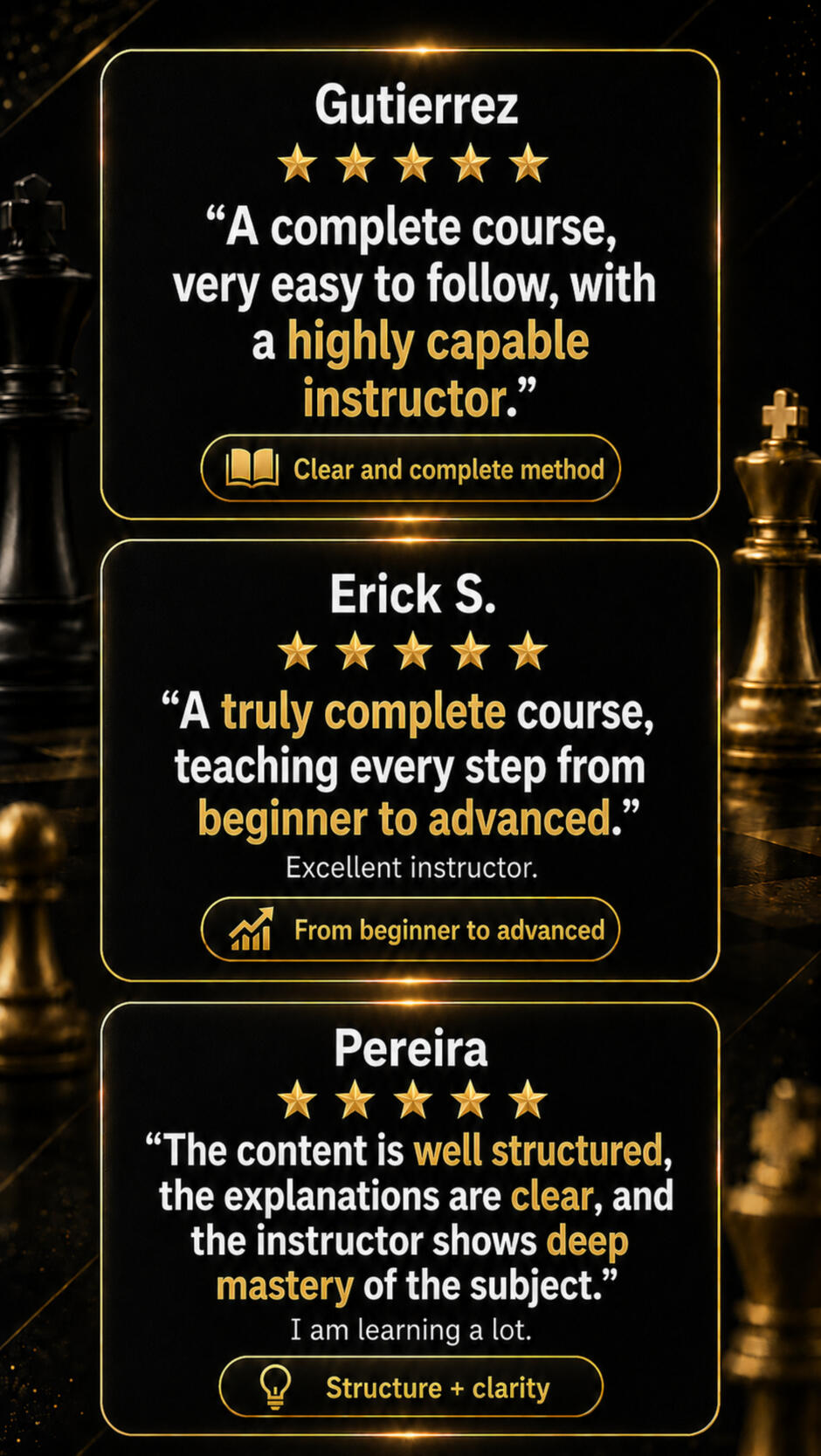
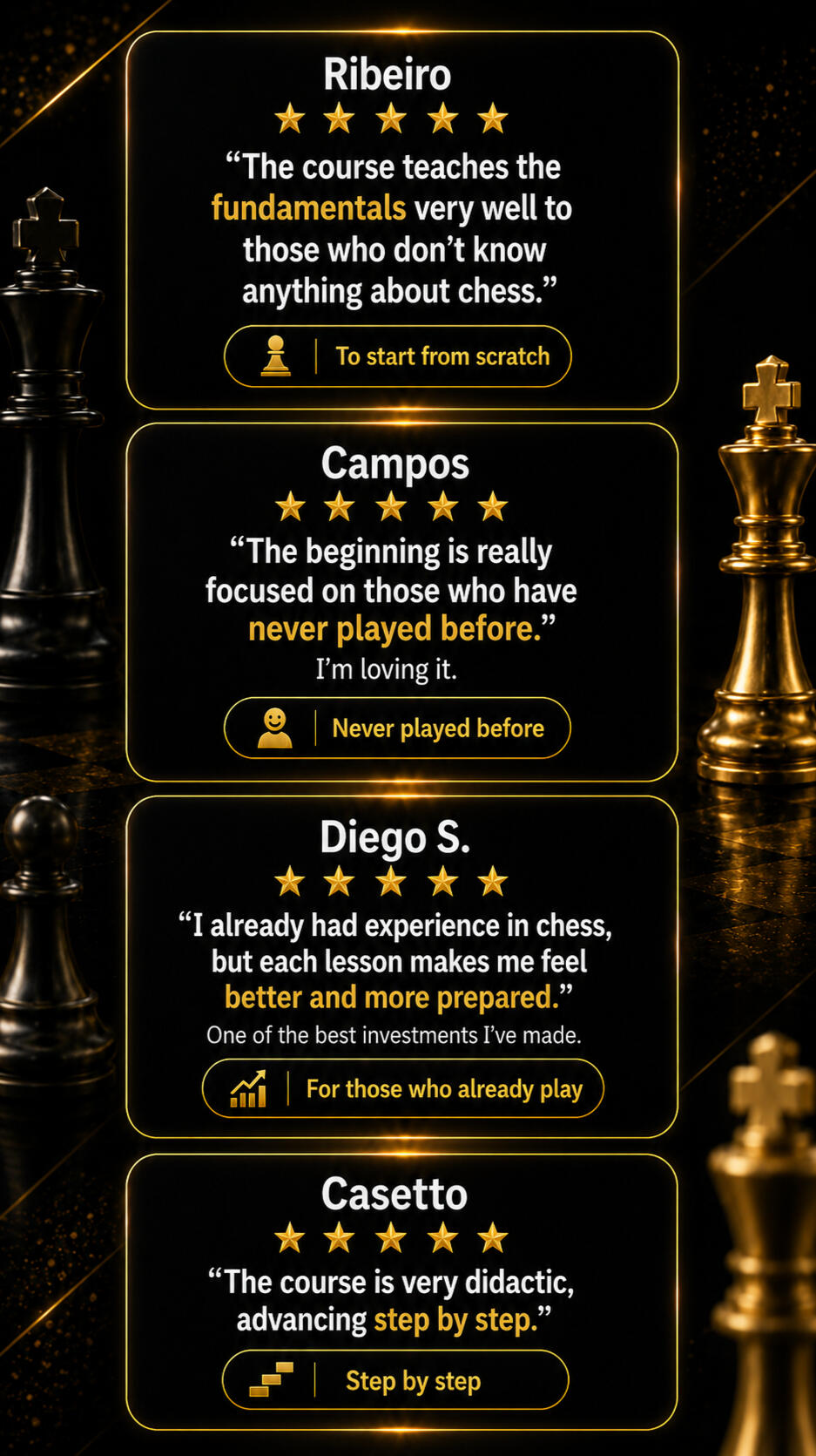
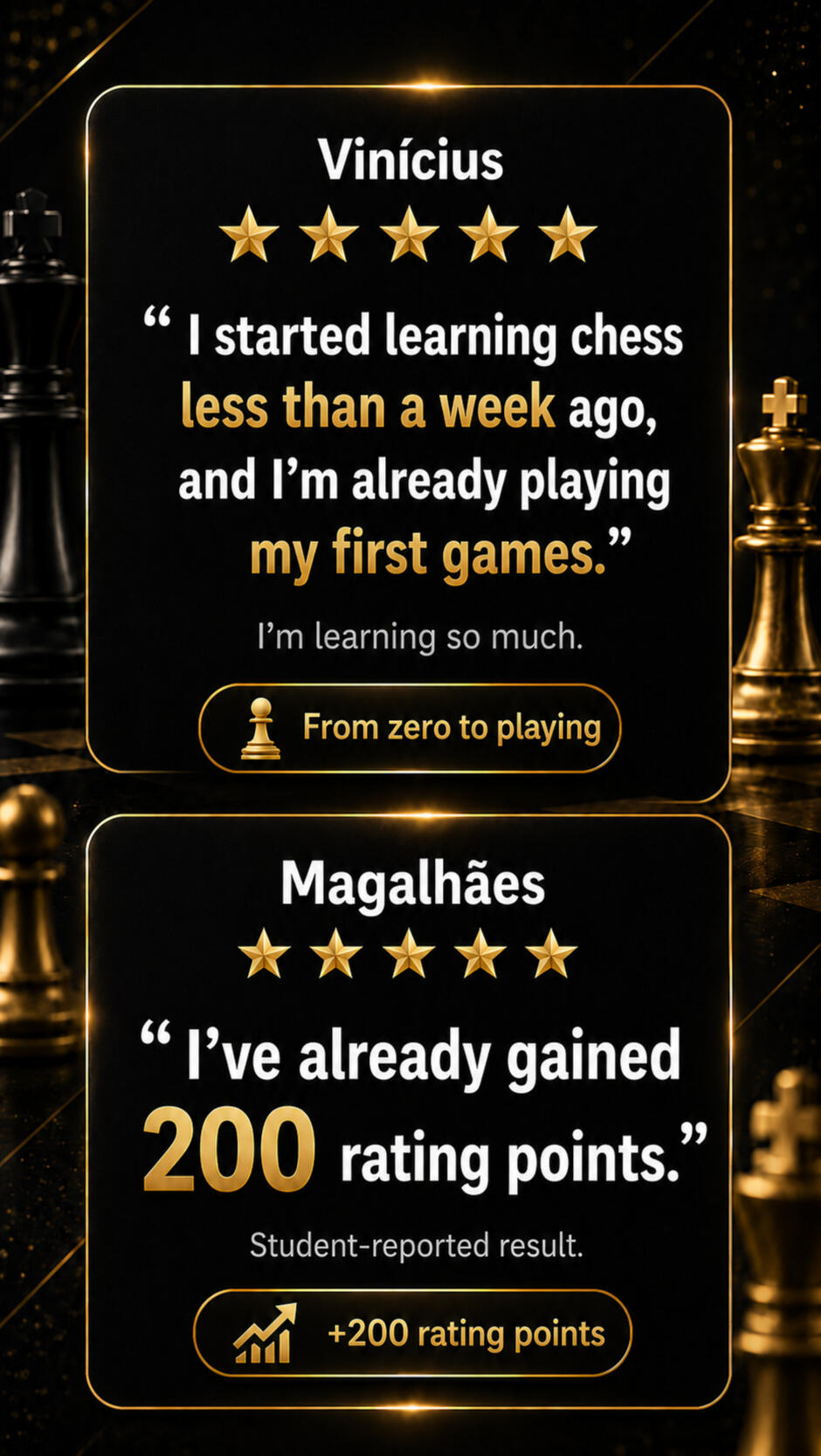
What students have already said about Professor Átila’s methodology

“I am 78 years old, and chess is an excellent pastime, as well as a challenging one. I am still learning, but the lessons are very clear and motivating. I started it as a pastime, but now it has become part of my daily life.”
— R. S. S.
“My goal is to reach a 2200 rating. I have improved a lot with the knowledge I gained. The content presented by Professor Átila is excellent.”
— P. L.
“The course is suitable for beginner, intermediate, and even advanced students. It is very complete, well designed, and organized in a logical sequence that leads to a better understanding of chess.”
— R. F. L.
“I noticed how much my game improved in tournaments and also on online chess sites. My experience with the method is one of gratitude, recognition, and improvement.”
— C. S. J.
“I decided to start by studying endgames, and I can say that the endgame lessons alone were already worth the investment. I will recommend the course to anyone interested in learning chess or improving their game.”
— V. P.
“Professor Átila’s tips are practical, valuable, and really work. The explanations are so good that they feel like they came from great chess books, with the advantage of being easier to understand and apply.”
— R. E. D.
“I really like the video lessons. They are very didactic, and with the review exercises, it becomes very easy to memorize.”
— J. V.
“The lessons are extremely didactic, very practical, and organized with progressive levels of depth. The video and audio quality is excellent.”
— V. C. R. P.

ChessForce: rating-based learning paths, progressive lessons, handpicked practice, and lifetime access.

How much would it cost to study all of this another way?

A single private chess lesson can cost more than lifetime access to ChessForce.And that does not mean private lessons are not valuable. On the contrary: individual guidance can be very important.But when it comes to building a foundation, reviewing fundamentals, and studying tactics, strategy, endgames, openings, attack, checkmate, grandmaster games, and repertoires, having an organized structure available whenever you need it completely changes the value you receive for the price.Private lesson: excellent for individual guidance, but usually charged by the hour or as a package.Subscription-based courses: you pay for as long as you want to keep your access active.Annual courses: you need to renew in order to continue accessing the content.ChessForce: you pay once and receive lifetime access, with no monthly fees, 307 video lessons, rating-based learning paths, handpicked practice activities, AI Chess Tutor, certificate of completion, Think Deeper bonus, and new updates included.

That is why the ChessForce Promotion is a special opportunity: you join once, study at your own pace, and keep access to the system whenever you want to review or move forward.

Join ChessForce today

Get access to the Progressive Chess System and follow an organized path to study with more direction, clarity, and consistency.ChessForce was created for players who want to stop studying chess randomly and follow a more structured path.You will get access to the lessons, rating-based learning paths, handpicked practice activities, special bonuses, and future system updates inside your student area.

What is included:

  • 307 organized video lessons

  • Game Rules stage + Force 1 to Force 11

  • Handpicked practice activities on Lichess.org

  • Bonus: ChessForce Think Deeper

  • AI Chess Tutor to answer questions about the course

  • Certificate of completion

  • Access through Hotmart on desktop and mobile

  • Option to download lessons in the app and watch offline

  • Lifetime access, no monthly fees

  • New updates included

  • 7-day unconditional guarantee

You have a 7-day unconditional guarantee. If ChessForce is not for you, simply request a refund within the guarantee period.
Still have questions?

See the answers to the most common questions before joining ChessForce.

1. Is ChessForce suitable for someone starting from zero?Yes. The system begins with the Game Rules stage, created for those who still need to learn or review the fundamentals before moving into the rating-based learning paths.2. I already play chess. Is it also for me?Yes. If you already play, you can use your Chess.com rating, your Lichess.org rating, or the level you usually play at in your chess app as a reference to choose the most appropriate learning path.3. Do I need to follow all the learning paths from the beginning?No. If you already have experience, you can start at the range closest to your current level. The idea is to enter at the right point and follow the sequence from there.4. Is access lifetime?Yes. You pay once and keep access to ChessForce, with no monthly fees.5. Does the course receive updates?Yes. When new content is added to ChessForce, you will continue receiving access inside your student area.6. Do all lessons include practical exercises?Not necessarily. At important points in the course, you will find selected practice activities, including CLDs, to reinforce essential themes. Some lessons are more conceptual, while others focus more on training and application.7. What is a CLD?CLD stands for ChessForce Learning Drills. These are selected practice activities designed to review patterns, apply studied ideas, and reinforce important themes from the course.8. Will I receive access to the Think Deeper tool?No. ChessForce Think Deeper is included as bonus lessons with visual positional analysis. You receive the recorded lessons, but not access to the tool used to produce the analyses.9. Can I study at my own pace?Yes. Since access is lifetime, you can study calmly, return to the lessons, review content, and move forward according to your availability.10. Can I watch on my phone and download lessons to watch offline?Yes. Access to ChessForce is provided through Hotmart, which has a mobile app. Through the app, you can study on your smartphone and download lessons to watch offline.11. Is there a guarantee?Yes. You have a 7-day unconditional guarantee. If ChessForce is not for you, simply request a refund within that period.
We respect your privacy. We do not sell your personal information. Any information you provide may be used to process your request, provide access to our content, improve your experience, and send communications when permitted by law. We process personal data in accordance with our Privacy Policy and applicable data protection laws. You may unsubscribe from our communications at any time.Privacy Policy - Terms of Use© ChessForce. All rights reserved.